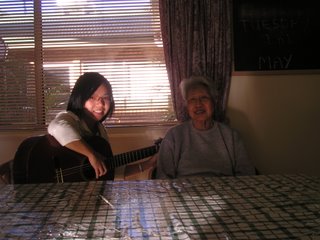
Hey guys! Here's my personal journey about music therapy in aged care. For those of you who have no idea what music therapy with this population is about, read on.....I hope to educate the public and to create an awareness in this area.
Feedback appreciated;)
Cheers!
-cheryl mow-
My first observation placement was at an aged care facility. It had 44 beds for residents with high care and low care and 1 bed for respite. Some of these residents have sensory impairment (blind), cognitive impairment (had brain injury, stroke, dementia), mental illness (schizophrenia, depression) and physical impairment (multiple sclerosis, immobility due to sickness). The hostel was divided into 3 lodges (15 beds in each lodge), which were named Kingfisher, Bellbird and Rosella. The Kingfisher lodge was designed for residents with dementia and it was where I observed most of the music therapy sessions (except one session at Bellbird) throughout my placement observation.
The environment was serene, with gardens, lots of greenery and was kept clean. Each resident had a room and a bathroom to themselves. I could see that the managers and staff (nurses, care givers, volunteers, Diversional therapist, music therapist and the chaplain), worked well together to help residents with activities of daily living and each of them portrayed a genuine care for the residents, through eye-contact, touch and facial response.
Initially, I did not know what to expect, as I had not much experience with aged care and it was not the population that I had in mind to work with as a music therapist in future. However, I was very impressed by the level of care showed by the staff and the environment of the hostel when I first stepped in. As I continued my placement observation, it opened my eyes to see what music therapy in aged care was about and what it meant to the residents. I began to realize how music therapy was able to help the residents socially, cognitively, physically, emotionally and mentally.
At first, I found it difficult to relate to the residents as I did not really know what to talk about and how to respond to them. Starting a conversation with the residents was a challenge to me. However, I managed to pick up some things to help me connect with the residents better by observing my supervisor, how she brought up topics to talk about and how songs were used as a platform to take the conversation further. On top of that, I also observed how the other staff communicated with the residents and took that as a lesson for me to follow. For example, communicating by looking straight at them, the posture (bending down to keep eye level the same as the residents’) when communicating, using touch and just being there to listen to them. These were some of the skills that I have picked up and applied.
In the later weeks, as I got to know the residents better, I felt more comfortable talking with them. Starting a conversation and having a conversation with them became easier for me. I realized that I do not necessary have to talk all the time and think of something to talk about continuously but that silence was good at times. I learnt the importance of being present for them. By knowing that the residents needed to feel accepted, loved and have a sense of security, staying silent did not make me feel uncomfortable after all.
Apart from that, I also began to understand more about dementia, about their behavioural changes (repetitive motion, having short term memory loss, wandering, easily agitated) and to be aware of them when communicating. Understanding their behavioural patterns helped me in my communication with the residents. For example, when a resident started talking about the same thing over and over again, I knew that he/she was not conscious about it, and it was probably something so dear to his/her heart that he/she remembered it so clearly. I have also learnt to evaluate and validate statements/behaviour portrayed by the residents by looking at their medical charts, talking to the nurses and carers, and refer to journal articles on related matters.
One-on-one music therapy sessions were conducted with selected residents to cater to their specific needs. Group sessions were conducted for all the residents who would like to attend. The group music therapy sessions had to be catered to residents with different cognitive levels and physical functioning levels. Residents were often respected for the choices they make and would be asked if they would like to attend the sessions.
I observed a one-on -music therapy with RA who was in dementia. He had some background in piano playing. During the session, he kept telling us about his mother who was a very good pianist and kept comparing himself with his mother. It seemed like he was a perfectionist and had low self-esteem because he could not play as well as his mother. He also kept saying that he could not play as well as he used to. This affected his confidence and self-esteem. He had high expectations of himself which were not met and was actually grieving the loss of his ability to play the piano because he used to play very well when he was younger.
At first, we had the music therapy session outside his room. The music therapist started off by asking him some questions about his musical background. Then, she showed him some music scores and asked him to name the notes in that song. He was hesitant at first, but when she helped him by pointing at the notes, he was able to name them. The music therapist then slowly encouraged him to get his hands on the piano and to have a feel of it once again. He was reluctant at first, but after much encouragement, he got to the piano. He managed to play some scales. He started off with one octave then 2, then 3 octaves. The music therapist suggested that each time he walked pass the piano, he could have a short practice.
Claire and Gibbons (cited in Davis, Gfeller and Thaut, 1999) demonstrated that older people have the capacity to develop music skills, maintain the skills they had throughout life, even if confined to a nursing home, suffered physical and cognitive limitations.
From my observation, RA repeated himself when talking. For example, he said that the piano he used to play was larger than the piano we had there. According to Davis, Gfeller and Thaut (1999), the central nervous system, which is the communication centre of the body do not regenerate neurons over time. Instead, the steady loss of brain tissue causes memory loss. That was the reason RA repeated himself without him realizing it.
The music therapist also used reality orientation to bring him out from the past and to make him realize who he is now. She asked him, “Who are you now?” He paused awhile at first and said his name. He then realized that he was the same person as before. Therefore, his musical skills and ability were still in him and he was still able to use them.
The week after, we tried to get him to play the piano again but at the same time we were careful not to make him do it as a chore, but for leisure. The other music therapy student and myself had an informal sing-a-long session with some of the residents and RA was there too. To our surprise, he walked up to the piano during the session to get a closer look at what we were playing. Then, we began to ask him if he would like to sit at the piano, which he willingly did. Comparing his response to the week before, he was more willing and sat voluntarily at the piano, where as he was reluctant to at the previous session.
He sat at the piano and tried playing for quite a long while and continued playing by himself although the rest of us have left the room. We allowed him to do so because he did say that he would like to practice on his own without anyone around.
This placement observation helped me understand the aged care population better in terms of their needs (social, physical, emotional, mental, cognitive, etc.), behavioural patterns, the aging process, the importance of having a good environment/surrounding, which included the level of comfort, warmth, cleanliness and the level of care that was needed for the residents.
Based on my observation, residents in aged care were often left out, isolated from their families and friends. They had lost intimacy with people closest to them for one reason or another. Friends and family members often felt that they had lost connection with the person they once knew, as the person grew older and suffered from dementia. Therefore, they were left to the carers and staff at the aged care to be looked after. However, it takes time for a person to get used to the new surrounding and people around there.
This was when I saw the importance of music therapy in this setting. Music therapy served as a connective tool to bring residents together and focus on a topic chosen by the residents themselves. At this level, music is a universal language that binds them together.
“When we sing or play instruments, we are called upon to connect our ears with our minds, our eyes with our hands, our thoughts with our feelings, unconscious fantasies with our conscious intentions, our beliefs with our actions, our inner worlds with the outer world, and ourselves to others.” Bruscia (1998).
During group music therapy sessions, social interaction was encouraged by remembering the names of the residents through songs and games. Playing the “balloon game”, passing it around from one to the other, kept the residents alert and I could see the sparkle in their faces when they often have flat facial expression. After the group sessions, residents would often want to talk to the therapist and want to spend some time with each other. The music therapist would make personal contact with each of the residents by showing affection and appreciation for them before leaving the room.
Music therapy sessions also encouraged meaningful interaction and proper behaviour such as respect for one another, turn taking and helping one another. For example, there were times when some of the residents had a little conflict, and the music therapist tried explaining things to them, helped them to resolve the issue, then continued on with the session.
At other times residents would say harsh words to the therapist at the beginning of the session, but as the session continued, there was a change in their behaviour. For example, once there was a resident who was not in a good mood and told the music therapist she looked ridiculous dancing by herself at the start of the music therapy session. However, as the session continued, the same resident became engaged in the balloon game and enjoyed herself after that, by taking the lead in the game. She reconnected with the music therapist during the music therapy session and asked the therapist to take her to her room. This showed that, the music therapy session was able to change a person’s behaviour and got the person reconnected with people.
I have also gained a better understanding about what it meant to have a music therapy session with the family members in a palliative care setting. The atmosphere was different as it was a solemn moment filled with emotions. The therapist started off with singing some of the client’s favourite songs, followed by some other songs upon request of the family members. The therapist stroked the client’s arm while talking to her. During certain songs, the client began tapping her hand, moved her lips and feet. Aldridge (1999) mentioned that the rhythmic stimuli stir up muscular tensions which were released physically by moving the hands, feet, and by smiling. This then directed the attention of the client towards things and events around them and caused them to have a deeper connection with the family. This literature supported my observation when I saw the client holding tight to the therapist’s hand in between the session, and there were emotional moments in the session. The therapist talked with the client like she understood everything that was said.
That session in palliative care had a great impact on my view of music therapy and how it was used as meaningful interaction between family members. At the moment where family members did not know how to connect/communicate with the dying person, music brought back sweet memories and cheer to the people. Music offered a non-verbal communication with the client.
Indeed music therapy played an important role in aged care. I had a talk with a resident, and she told me that it was something she looked forward to each week. It then dawned upon me, that truly music therapy sessions in an aged care facility have impacted the lives of the residents in a positive way, physically, mentally, emotionally, spiritually, socially and cognitively.


